
人生无法设对照,因为世上只有一个你——2017年诺贝尔生理学/医学奖获得者Michael Rosbash教授谈科学人生
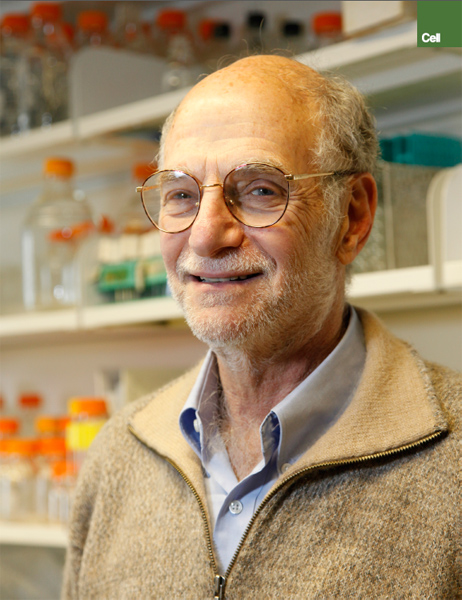
Michael Rosbash在实验室
但凡投稿《细胞》杂志者,内心无不历经乞盼、渴求、忐忑或因稿件被拒而郁闷、焦躁甚至愤怒。本稿能逃过此“劫”,皆因《细胞》杂志编辑玛塔·科赫女士(Marta Koch)约稿,让我写一篇短文讲讲往事之故。我很想把自己与《细胞》杂志间那些久远而精彩的故事尽数相告,然,三言两语实难详尽,故在此只展现一段与众不同的个人经历。
此次摘得诺奖,可以从如下几方面进行评价。一则,其褒奖了我们为昼夜节律机制做出的重大贡献;二则,其盛赞基础科学,突出模式生物对于研究的重要意义;三则,其让果蝇这一卓尔不凡的小动物再次身显名扬,这也是第五座因果蝇而获得的诺奖,并且这是自1995年以来果蝇首次“演独角”(这让我想起了梅丽尔·斯特里普与奥斯卡奖);四则,其凸显了基因与行为之间的关系。
关于行为特征的遗传学说,也就是先天后天之争中的“先天”,它有着一段混沌的历史。优生学使其名誉扫地,在美国又被斯金纳主义压倒,后者认为环境,也就是“后天”,决定行为。双生子研究以及许多不可靠的心理学研究促使研究方向又摆向主张“遗传决定行为”。时下流行的表观遗传学思潮,又把我们带回了支持“后天决定行为”的阵营。虽然表观遗传学一词已经被组蛋白-染色质领域强行霸占,但这一术语最初是由C.H.Waddington(译者注:英国发育生物学家、古生物学家、遗传学家、胚胎学家和哲学家)提出,在这一语境下自然可以理解为“环境影响或发育噪音”,也就是说在固定的遗传途径之外,影响表型的任何因素。此外,宿命论通常不招人喜欢,这就增加了非遗传性影响的吸引力。
这就是我出场的背景。我在布兰迪斯大学研究基因表达和RNA,结识了同校的杰夫·霍尔(Jeff Hall)教授,若干年后开始在昼夜节律和果蝇周期基因方面展开合作。我从事这项研究的原因之一是我一直对基因与行为之间的关系感兴趣。尤其想知道:我怎么好像总是在惹麻烦?究竟是先天的还是后天的因素导致?是基因使然,还是环境影响?
从我记事起,主要是从中学开始,我在学校里就麻烦不断。我不是指学业上的麻烦;我一直是好学生(好,并不意味着优异,因为我对于学习一直不上心,直到在加州理工学院大二读到一半时,突然被学术魅力打动,醍醐灌顶,之后才开始好好学习。我姗姗晚成,走上科研道路可能与我的行为问题不相关,这个话题改天再细说)。但是,进入加州理工学院之前,我在纽顿公立中学读书期间有比较严重的行为问题。我当时爱多嘴、吵闹,尤其厌恶权威,厌恶别人指挥我做什么,不做什么。我还时常挑战他人的禁忌和底线。令人惊讶的是,回首往事,在加州理工读本科和麻省理工读博期间,这并没让我显得另类或遇到什么麻烦。因为这两所高校到处都是性格古怪之人,学校对精英人才格外宽容;只要你学有所成、学术优异,不是过于恶劣的行为问题都可以被忽略不计。其实,打破陈规旧习,敢于改变现状,正是创新性研究不可或缺的重要组成部分,所以我在这两所学府过得如鱼得水。
然而,在爱丁堡做博士后期间,尤其是在布兰迪斯大学任助理教授期间,我的这种性格还是带来了麻烦。此事虽冗长繁杂,但我对前辈、权威缺乏尊重的行为屡见不鲜。虽然部分原因是作为学生的我,在二十世纪六十年代后期在政治活动上极为活跃(“永远别相信40岁以上的人”),此外还有一些非常独特且复杂的当地因素,但我青少年时代出现的问题仍然存在,而且并非毫不相关。
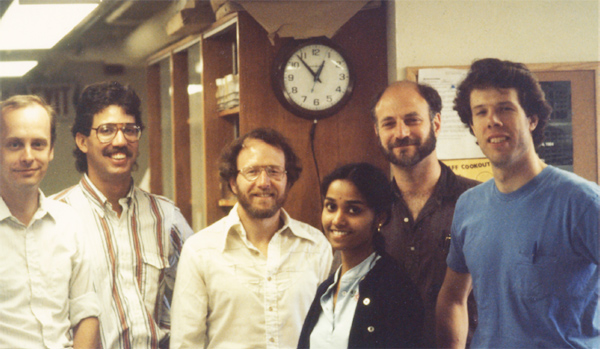
昼夜节律研究团队初期大部分成员。从左到右依次为Will Zehring, Tony (A.A.) James, Jeff Hall, Pranitha Reddy, Michael Rosbash, Dave Wheeler。摄于1985年。
1974年我到布兰迪斯大学工作后,我的实验室就一直在罗森斯蒂尔研究中心(Rosenstiel Center)。尽管我学术成果丰硕,项目基金颇多,但该研究中心因为我与前辈、权威之间的那些冲突,给出了否定意见,拒绝授予我终身教职。当时如果助理教授想获得终身教职,需两方给出意见:一方是研究中心,另一方是当事人所在学系。我当时是在生物学系。与研究中心的意见不同,生物学系以微弱的赞成票优势支持我获得终身教职。这种情况前所未见,最后只好交由布兰迪斯大学校长做出最终裁定。他授予了我大学终身教职,但要求我将实验室从研究中心搬迁到生物学系。因为寻找实验室地点和配备实验室设施方面遇到了困难,实验室搬迁比预期滞后。最终我在1982年8月将实验室搬到了Bassine生物楼。机缘巧合,我的新实验室和合作伙伴杰弗里·霍尔(Jeff Hall)的实验室竟然在同一层。我们甚至共用一个研讨午餐厅,因为这个餐厅在我们两个实验室中间。大概两个月之后,也就是1982年10月,我们研究上的合作开始了。
如前所述,我开展基因-行为间关系研究的动机之一是我自己的性格特征:我何以如此?其中原因太过复杂,一篇短文难以解释清楚。我一直倾向于认为遗传或“硬编码”决定人的行为。我们对果蝇进行的基因-行为间关系研究强化了我的这一倾向认识,尽管果蝇研究与我思考的人类行为问题之间有天壤之别。但是,有一条重要论据能支持后天环境因素造就我的性格特征这一说法,那就是家父在1954年因突发心脏病猝死,当时我也就10岁,读六年级。这一不幸不仅使我失去了父亲和人生的男性榜样,而且彻底动摇了我们这个小家庭。我茫然无助,没有人可以作为我的情感依靠。此外,这个世界,至少是我母亲,在二十世纪五十年代时应对这一不幸的方式与当今时代大相径庭。例如,父亲过世之后,家人从未在交谈中再提起过他。那时我正读初中,我记得第一次在学校惹麻烦也是那个时候,这会让人觉得这个事件是影响我性格的重要因素。这个解释的确讲得通,多年来我有两个见多识广的朋友也颇为认同,甚至连我自己也常常这样想。
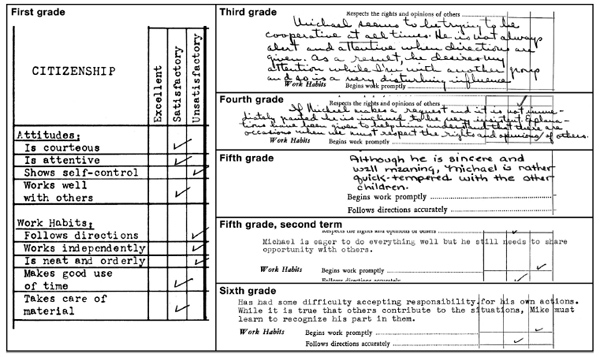
学校成绩单
当然,我当时并未弄明白如何研究人的性格这一复杂问题,对此我暂时搁置,而专心于昼夜节律研究,数十年间不断取得进展。老化(有人将其称为成熟)也让长期以来带给我麻烦不断的那些难搞的性格特征被抛之脑后。但是,也有人对关于老化或成熟的上述观点提出反驳:我家人时至今日仍然受不了Larry David(译者注:美国演员、编剧),就是因为他和同时代的我太像了,不只是外貌体型像。我女儿不久前还和别人说过“为什么要看《抑制热情》(译者注:Larry David编剧、主演的美国喜剧)?拜托,我们时时刻刻都要忍受他的类似行为。”因此,在我获得终生教职和搬迁实验室之后,35年来发生的变化可能都是表面的,而非深入性格。
然而,关于我性格及其起源的问题在2009年再度出现。我65岁生日时,生物系办了一场研讨会和生日派对,许多曾与我共事的人都回来参加了这个研讨会。在最后的演讲中,我需要回顾一下过去,因此我决定探究一下这个问题。我当时也觉得可以让这些共过事的人和现在的同事们开心一下,他们都真真切切体验过我坦率的性格。
还有一件事情也推动着我探索自己的性格。2008年,也就是这次研讨会的前一年,家母过世,享年94岁。您看,人生真是失之东隅,收之桑榆!(上帝啊,如果她活至今日,见我喜获诺奖,必心生得意!)她一直珍藏着我从小到大的各种纪念品,尤其是我的成绩报告单和小时候的笔记。请注意,除了六年级的成绩报告是个例外,在家父过世之前,我其他年级的成绩报告单还是可圈可点,在我看来,这些确凿数据让我坚信“硬编码”的解释。
人生无法设对照,因为世上只有一个你。也许早年经历的环境世事塑造了我的性格。不过就生物-哲学架构而言,我不是“自由意志”的拥趸。我对遗传学或硬编码的偏爱,让我不畏责任担当,敢于质疑一切。人生与概率系数相关,人生没有定数。正如我在实验室常说,“打赌吧,我赌十之八九是硬编码决定行为”,或者我两边都下注,就会说“打赌吧,我赌十之八九主要是硬编码决定行为”。君须牢记,怀疑和好奇是科学研究的动力。
附英文原文:
Life Is an N of 1
Michael Rosbash
It is a strange feeling not to anticipate begging, pleading, sweating, or getting angry at a rejection letter/email when crafting a manuscript for Cell. This manuscript will presumably escape that torture as it is a brief, personal story invited by the Cell editor Marta Koch. I was sorely tempted to tell the tale of my long and colorful history with Cell. However, it cannot be brief, so here is a different piece of personal history.
Our Nobel Prize can be seen from several perspectives. It is for making important contributions to the mechanistic underpinnings of circadian rhythms. It celebrates basic science, emphasizes the importance of model organisms to research, and elevates Drosophila once again to a starring role. It is the fifth Prize for this remarkable, little beast and its first as a solo performer since 1995. (The metaphor makes me think of Meryl Streep and the Oscars.) Lastly, the Prize can be seen as underscoring the relationship between genes and behavior.
The inheritance of behavioral traits—the "nature" in the nature-nurture debate—has a murky history. Eugenics gave it a bad rap, and it was overtaken in the US by Skinnerism and its emphasis on the environment—or "nurture"—in determining behavior. Twin studies as well as the dubious nature of many of those psychological studies contributed to swinging the pendulum back in the other direction toward inheritance. It has been followed by the current zeitgeist of epigenetics, which takes us back to the nurture camp. Although the word epigenetics has been hijacked by the histone-chromatin field, the term as originally coined by C.H.Waddington can be conveniently viewed in this context as environmental influence or developmental noise, i.e., anything that influences phenotype other than a fixed genetic path. In addition, determinism is generally unattractive, which adds to the appeal of non-genetic influences.
It is against this backdrop that I entered the story. I was studying gene expression and RNA at Brandeis when I met Jeff Hall, also a professor at Brandeis, and began some years later to collaborate on circadian rhythms and the Drosophila period gene. Among the many reasons I began this work was the fact that I had always been interested in the relationship of genes and behavior. In particular, why did I always seem to court trouble? Was it nature or nurture, my genes or some environmental event?
Ever since I can remember, mostly since middle school, I had trouble at school. I do not mean academic trouble; I was always a good student. (Good does not mean outstanding, as I was largely indifferent to learning until mid-way through my second year at Caltech when I was bitten by the academic bug. My delayed path was probably not unrelated to my behavioral issues, but this is another story for another time.) However, I had quasi-serious behavioral issues in the Newton Public Schools before Caltech. I had a big mouth, was rowdy, and most importantly, really disliked authority—being told what to do. I also pushed buttons, and limits. Remarkably in hindsight, this caused me little trouble at Caltech as an undergraduate and at MIT as a PhD student. Both institutions were filled with weird characters and were remarkably tolerant meritocracies;if you could perform, everyone ignored all but the worst behavioral issues. And some iconoclastic behavior, a lack of respect for the status quo, is part of doing original research. So I thrived at both institutions.
However, my character traits contributed to some trouble during my post-doc in Edinburgh and especially as an assistant professor at Brandeis. Although a much longer and more complicated story, I really lacked respect for my elders, which was frequently visible if not audible. Although some of this was due to my having been a politically engaged student in the late 60s ("Never trust anyone over 40") as well as some very different and complicating local factors, my issues from adolescence still existed and were not irrelevant.
These conflicts with authority led to my being denied tenure in the Rosenstiel Center, where my laboratory had resided since I had been hired in 1974. The negative recommendation was despite my strong publication and grant record. There were at the time two parallel tenure decisions required for Rosenstiel Center assistant professors: one in the Center and the other in the academic department of the candidate—in my case, Biology. In contrast to the Center decision, the Biology Department voted to recommend me for tenure albeit narrowly. This was a novel conflict, which landed on the desk of the Brandeis President for adjudication. He granted me University tenure but required that my lab vacate the Rosenstiel Center and that I move to Biology. The move was delayed because the University had some trouble finding and then outfitting adequate space, but I finally moved in August of 1982, to the Bassine Biology building. Strictly by chance, my new space turned out to be on the same floor as the lab of my pal Jeff Hall. We even shared a seminar-lunchroom, which was situated between the two labs. About 2 months later, in October of 1982, we began our collaborative work.
As I indicated above, one motivation to begin this gene-behavior work was my own character: how did it come about? For reasons that are too complicated to explain in a short essay. I was always partial to genetic or "hard-wiring" as responsible for human behavior. Our own gene-behavior research on fruit flies reinforced this prejudice, despite the sea of differences between this work and the kind of human question I had been pondering. However, there was one substantial argument in favor of an environmental explanation for my character: my father died of a sudden heart attack in 1954, when I was 10 years old and in 6th grade. This tragedy not only left me without a father and male role model but also shook our nuclear family to its core. I was set adrift and had a hard time finding some emotional center of gravity. Moreover, the world or at least my mother handled this tragedy much differently in the 1950s than one would today;for example, my father was never mentioned in our house again after his death. As the timing coincided roughly with middle school, indeed with my first memories of school troubles, this seemed a good candidate for a major contribution to my character. It was certainly a viable explanation, which resonated with a couple of my more-sophisticated friends over the years and even with me from time to time.
Of course I never figured out how to investigate a human character question of this complexity,and therefore I left it behind as our circadian work progressed over the decades. Aging—some would say maturing—also left behind many of those difficult character traits that caused me so much trouble for so long. However, here is a counterargument to the aging or maturing description:my family to this day has been unable to tolerate Larry David because of his similarity to the contemporary Michael Rosbash. The resemblance is not only physical. My daughter said to someone not long ago: "Watch Curb Your Enthusiasm? Get real;we live with this kind of behavior all the time."So maybe the changes over the 35 years since tenure and my laboratory move are more superficial than profound.
Nonetheless, the question of my character and its origins reemerged in 2009. I had a 65th birthday symposium and party for the Biology Department and for my many trainees who returned to campus for the symposium. As my final talk required some reflection, I decided to explore this issue. I also thought it might amuse my trainees and colleagues, all of whom had experienced some version of my unvarnished character.
I was aided in this quest—and not without some irony you will appreciate—by my mother’s death the year before in 2008, when she was 94 years old. (My Lord, would she be kvelling had she lived to see this day!) She had kept all sorts of memorabilia from my childhood, including most notably my report cards and notes from my earliest years. Note that with the possible exception of my 6th grade report card, they all occurred well before my father’s death and therefore provide in my opinion unambiguous data in favor of a hard-wiring explanation.
There are of course no control experiments in life; everything is an N of 1, so maybe some earlier environmental event strongly contributed to my character. I also note that my preference for genetics or hard-wiring does not absolve me of responsibility, although I am still not a fan of free will as a biological-philosophical construct. And I tend to doubt almost everything, so all of these issues as well as most others must be associated with probability coefficients; there is no certainty.Or as I like to say in the lab: "I’ll give you 5-to-1 odds that it’s hard-wiring." And to hedge even more strongly, "I’ll give you 5:1 that it’s mostly hard-wiring."Don’t forget: doubt as well as curiosity is a motive for doing scientific research.